Climate Change
Energy and Greenhouse Gas (GHG) Emissions
Our Paths to Carbon Neutrality
Climate change is reshaping how businesses operate and how they are evaluated by customers, investors and regulators—creating risks and opportunities across all industries.
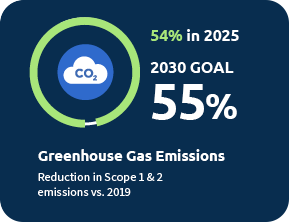
At Avient, our approach to sustainability is built around the needs of our customers and the industries we serve. We recognize the value of sustainable business practices and are working across our supply chain and with stakeholders to address the carbon emissions that contribute to climate change. As we work toward our 2030 greenhouse gas emissions reduction and renewable electricity goals within our own operations, we continue to develop solutions that help customers meet their own sustainability commitments. We believe strong leadership and continued action are essential to building the resilient supply chains our customers depend on.
In support of the objectives of the Paris Agreement, Avient is committed to achieving operational carbon neutrality by 2050, with goals aligned to our RE100 commitment. We know the path will not be easy, and are working with internal and external stakeholders to understand how we can achieve our goal for our operations to be carbon neutral in line with climate science. We are also finding new ways of operating, adopting new technologies, and innovating more sustainable products. Some technologies needed are not yet available at scale, which limits our ability to take certain actions in the short term. However, by taking advantage of developments in longer-term carbon management and removal technologies, as well as circularity, we are committed to enabling positive climate impacts across our value chain.

To advance these commitments, Avient has focused its continuous improvement efforts on:
- Investing in resources and existing technologies to optimize operations, including improvements in energy efficiency and waste reduction
- Adopting new technologies in our global network of facilities
- Maximizing the use of renewable energy in our operations
- Continuing to develop new and innovative products that have sustainability attributes that decrease GHG emissions and enable the world’s transition to a lower-carbon economy
- Advancing circularity in our operations and our customers’ products
- Partnering with our suppliers to enhance the eco-efficiency of our supply chain
We value collaboration and partnership across the value chain to drive change, and are committed to engaging with our customers, suppliers, and other partners to encourage collective action and help promote the innovations needed to enable a sustainable world.
Better Plants
Avient has partnered with the U.S. Department of Energy’s Better Plants Program since 2023. Our participation in this program is another step in our commitment to enhancing our operational energy efficiency. As part of our alignment with Better Plants, we have pledged to reduce our energy intensity by 25% over the course of 10 years, demonstrating our dedication to sustainable practices and bolstering our competitiveness in the industry.
Energy and Greenhouse Gas (GHG) Emissions
To drive progress toward carbon neutrality, Avient’s low carbon transition plan targets intermediate (2030) goals around Scope 1 (direct) and Scope 2 (indirect) sources of greenhouse gas emissions. These targets are in line with prevailing climate science limits that keep global warming below 2 degrees Celsius, as detailed by the Paris Agreement and Science-Based Target Initiative (SBTi).
To better reflect the actual price of CO2 to society, and ensure costs are within the ranges of the scenarios we use for assessing climate transition risks, Avient has instituted an internal cost of carbon aligned with the range used in our climate transition risk scenarios, ensuring that investment decisions reflect the true cost of emissions. This tool encourages investments in low-carbon and carbon-free technologies while increasing the visibility of, and encouraging accountability for, the impact of carbon emissions on the business.
Avient’s approach to reducing our greenhouse gases and other emissions is focused on four main areas:
- Improving equipment and building energy efficiency
- Process transformation
- Expanding the use of renewable or low-carbon energy
- Supporting technology breakthroughs by meeting our customers’ sustainable solution needs
The overall management strategy for our emission reduction program is led by Avient’s Planet Sub-Committee of the Sustainability Council. This committee is comprised of global operations, engineering, and sourcing leaders and ensures continual progress towards our sustainability goals and operational efficiency goals. Execution of this strategy is achieved by our business units working closely with individual facilities, the EH&S team, and the Planet Sub-Committee.
Most of Avient’s Scope 1 and 2 GHG emissions are attributed to the consumption of energy. The primary energy source at our facilities is electric power, followed by natural gas. Details of our energy sources can be found in the Metrics section. Strategic plans at the facility and business unit level include planned efforts to achieve sustainability and operational goals. In 2025, we were able to further optimize energy consumption by initiating or implementing 108 energy reduction projects around the world, resulting in 11,426 MWh in energy savings. Additionally, Avient Energy Project Awards were presented for projects completed in 2025 and included categories such as Most Creative Solution, Best Low- or No-Cost, People’s Choice, and Best Overall.
For detailed information on these projects, our energy and third-party verified carbon emissions performance, risks and opportunities presented by climate change, and associated governance systems, we invite you to read our most recent Climate Change Report submitted to CDP.
Reducing Emissions Across Our Value Chain
Scope 3 emissions include upstream emissions from products and services we procure from suppliers, as well as downstream emissions from the processing of our sold products and the emissions generated from their use and disposal. Avient captures information related to all relevant categories of these emissions because understanding our value-chain footprint is essential to identifying the most meaningful opportunities to collaborate and reduce emissions. Scope 3 emissions are many times greater than our combined Scope 1 and 2 emissions, which is why value-chain engagement is a critical part of our climate strategy.
Approximately 60% of Avient’s Scope 3 emissions come from purchased goods & services, downstream processing of sold products and downstream transportation & distribution (15%, 17% and 28%, respectively). This profile underscores the importance of partnering with suppliers and customers to improve data quality and accelerate decarbonization across our value chain. To strengthen our Scope 3 program, in 2025 Avient initiated a targeted assessment of suppliers making up 80% of our raw material purchase by volume to evaluate the availability of carbon emissions data and reduction plans.
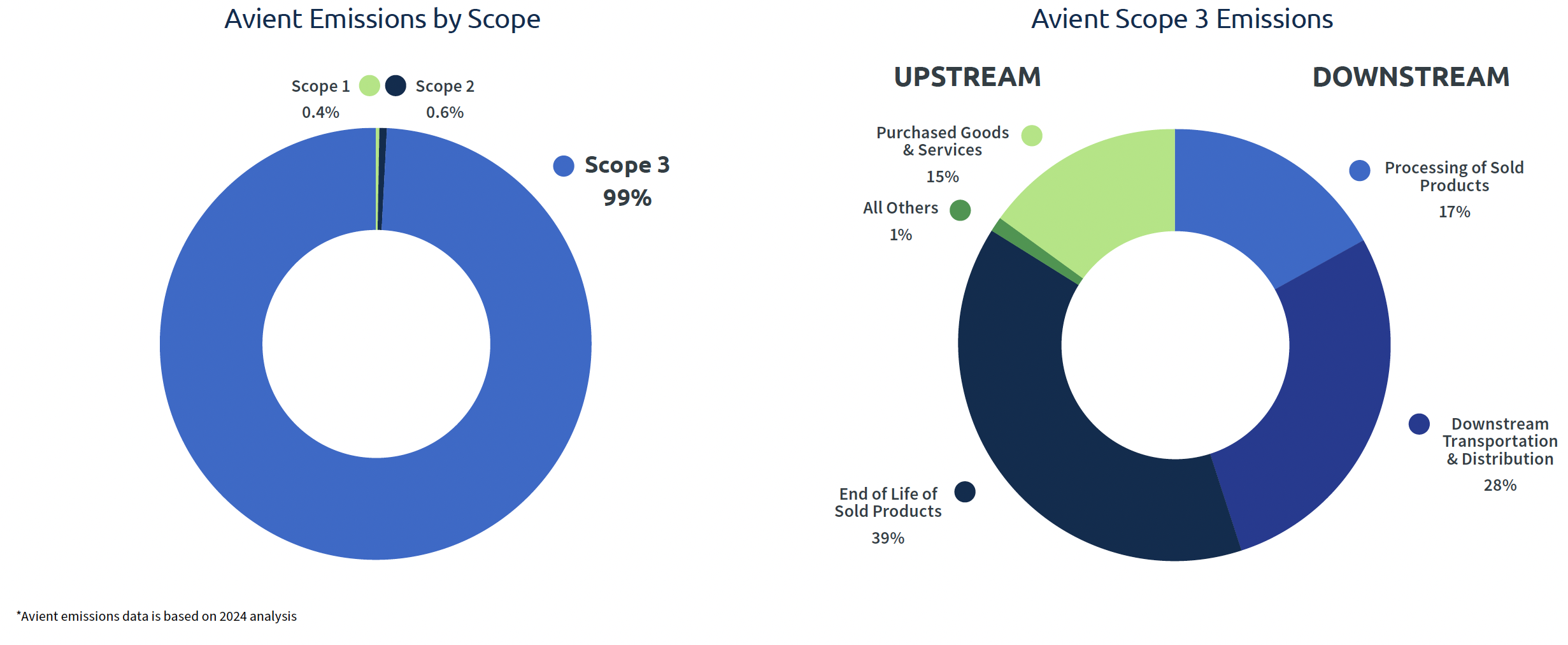
Our 2025 assessment revealed that 42% of our targeted suppliers already have greenhouse gas commitments in place—and we are actively engaging the remaining 58% through education, data-sharing, and collaborative goal-setting to accelerate progress across our value chain.
Accuracy of Scope 3 emissions estimates is important to Avient. Estimating Scope 3 emissions can be especially challenging for companies like Avient that manufacture intermediate materials for highly diversified portfolios. Downstream emissions vary significantly depending on end-use applications. The GHG Protocol’s Scope 3 Calculation Guidance recognizes this complexity. We continue to raise awareness about our need for more Scope 3 emission tracking. Additionally, as we collaborate with customers to meet their business needs and achieve their sustainability goals, we work to help them reduce their Scope 1 and 2 emissions. As an innovator of intermediate materials serving diverse end markets, we recognize that Scope 3 measurement will continue to evolve. We are committed to improving data quality, scaling successful supplier engagement models, and transparently reporting our progress.